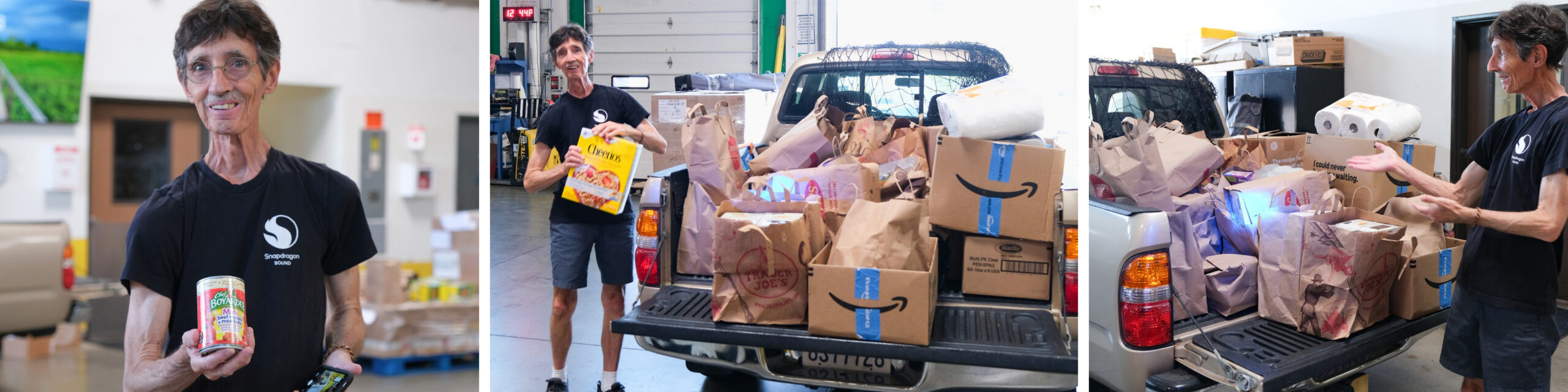
On the first Friday of every month, bags of groceries appear on front porches across Talmadge. By the end of the day, a small team of volunteers has collected them, loaded them into their cars, and delivered them to the Jacobs & Cushman San Diego Food Bank.
The Off My Talmadge Porch neighborhood food drive began in 2020 with an idea from Talmadge real estate agent Afton Miller. Six years later, Afton and her business partner, Logan Henry, have helped their neighbors donate more than 66,000 pounds of food, enough for more than 55,000 meals for San Diegans facing hunger. The model is simple enough that Afton believes almost any neighborhood could make it work.
The Talmadge Porch Pickup Food Drive at a Glance
• Started: 2020
• Pickup day: The first Friday of every month
• Reach: Printed flyers go to roughly 1,200 Talmadge homes each month
• Volunteers: About 12 each month, plus a coordinator
• Average donation: More than 1,300 pounds of food per month
• Total donated: More than 66,000 pounds since October 2020
How the Talmadge Food Drive Started
Afton had been turning the idea over for a while. “It had been in my mind two or three years before I actually put the gears to work,” she says. “I just thought it would be a good community project.”
Neighbors had once tried a food drive at the Talmadge traffic circle, a central meeting spot, but donors had to bring their food there. Afton wondered what would happen if the drive came to them instead.
“I thought, what if there was a monthly food drive where the food got picked up off your porch? Then there would be a lot more participation, because you didn’t have to go anywhere,” Afton says. “You had to buy the food, but you gotta buy food anyway, and you just put it on your porch the first Friday of every month.”
Logan joined Afton as her business partner about four years ago and has been part of the drive ever since. “He’s all in on it,” she says.
How a Porch Pickup Food Drive Works, Step by Step
Each month follows the same rhythm, and coordinator Melissa Dewey keeps every piece moving.
1. Flyers Reach Every Porch About a Week Ahead
Four to eight days before pickup, volunteers deliver printed flyers to roughly 1,200 homes. Covering the neighborhood takes about 14 hours of walking, shared among about five volunteers who each take as many homes as their schedules allow. Melissa builds a custom route map and flyer bundle for each of them every month.
After six years, the drive also has a large email list. The team has tested going paperless, and the flyer stays. “We’ve experimented and found out without the flyer, we don’t get as much participation,” Afton says.
2. Neighbors Sign Up by Email or Text
Households that plan to give send a quick email or text. Melissa tracks every response, answers questions, and sorts participating homes by location so pickup routes stay short. Some neighbors give every month, some give now and then, and new households join regularly.
3. Volunteers Collect Food on the First Friday
On pickup day, four volunteers drive the routes and gather bags from porches. Everything comes back to Afton’s house first.
The system has become so familiar that neighbors who miss pickup day often leave food on Afton’s porch instead, and the team holds it for the next month’s delivery. “They don’t even have to call me or tell me anymore, they just do it,” she says.
4. The Food Goes to the San Diego Food Bank
Two vehicles, occasionally three, carry the food to our warehouse, where we weigh every delivery. Some months, volunteers fill every seat and cargo space. One neighbor contributes 60 boxes of cereal every month.
“I mean, it’s pretty heartwarming,” Afton says. Once it arrives, the food joins what we distribute to approximately 400,000 neighbors across San Diego County each month [link: /about/hunger-facts-research/].
The Volunteers Behind Every Delivery
About 12 volunteers power the drive each month, and many fill more than one role. The people who drive food to the Food Bank have often spent the morning collecting it. Each volunteer gives about two to two and a half hours a month, while Melissa puts in roughly 15.
Afton is quick to credit the coordinator role. “That person by far does the most work,” she says. “It’s almost like a mini job.”
Talmadge residents of all ages take part, from their mid-30s to their 80s, and most volunteers are 60 or older. A core group stays steady. When a few step away, others step in, often after retiring and finding more free time.
“To me, the volunteers are like, they’re everything,” Afton says.
Why Food Drive Donations Climb in November
November is consistently the drive’s biggest month. Food Bank records show Talmadge neighbors donated more than 5,000 pounds in November 2024, roughly four times a typical month, and more than 2,600 pounds in November 2025.
The team doesn’t change anything about the drive that month. “I think it’s because of Thanksgiving,” Afton says.
The holiday season is when many San Diegans look for ways to give food. Our annual Holiday Food Drive [link: /holiday-food-drive/] runs through the season, and neighborhood drives like this one are part of how the county comes together to stock our shelves.
What Does It Take to Start a Neighborhood Food Drive?
According to Afton, it takes fewer people than you might think. “It’s not that hard to implement. I mean, it’s really pretty simple. Pretty straightforward,” she says. “Another neighborhood just needs to get five core volunteers and, you know, it would go from there.”
She suggests starting with about 500 homes and growing from there, whether in Kensington, North Park, Clairemont, or anywhere else. The Talmadge model offers a few lessons for any group getting started:
- Pick one consistent day. A standing date, like the first Friday of the month, helps neighbors build a habit.
- Put a printed flyer on every porch. Talmadge found that email alone doesn’t replace a physical reminder.
- Name a coordinator. One person managing sign-ups, routes, and questions keeps volunteers free to walk and drive.
- Map routes by location. Grouping nearby homes keeps pickup day short.
- Plan for late donations. A designated drop spot catches food from neighbors who miss pickup.
- Start small, then expand. A few hundred homes is enough to learn the rhythm.
“Don’t you wish a whole lot of other neighborhoods are doing this?” Afton asks.
Bring a Food Drive to Your Neighborhood
“Talmadge truly is a community,” Afton says. You can build the same kind of momentum where you live.
You can host a food drive in your own neighborhood, and our food drive toolkit includes materials to spread the word. Once your plans are set, register your food drive so we can support you along the way. If porch pickups aren’t practical, a virtual food drive lets neighbors give from anywhere. You can also drop off donations at our warehouse, or find a volunteer shift at our Miramar or Vista locations.