“I never saw it coming.”
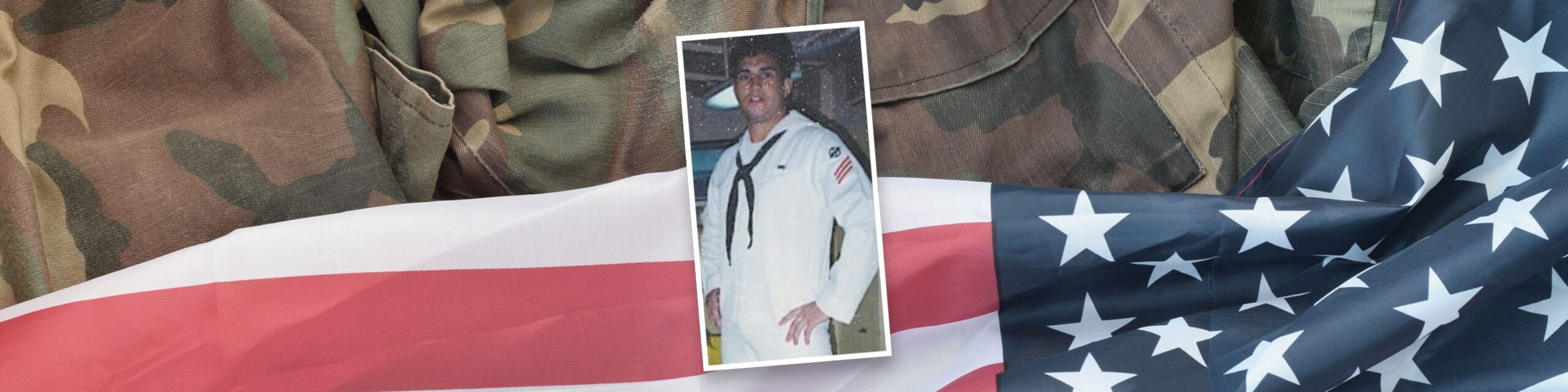
Scott, a U.S. Navy Gulf War combat veteran, pictured in 1990 as he prepared to deploy to the Gulf.
For most of his life, Santee resident Scott Brown was the one helping others. A U.S. Navy veteran and former director for a steel and solar energy company, Scott built a successful career and took pride in giving back, donating both time and money to local charities and food pantries.
It wasn’t until illnesses in recent years left him bouncing from hospital stay to hospital stay that he found himself in a place he never expected: struggling to afford food.
“I have a nice six-figure salary and everything is going great, then all of a sudden, I end up with a rare disease and my health just starts going from bad to worse,” Scott shares.
In 2016, Scott underwent major surgery to remove part of his colon and intestines. Six months later, he developed diabetes. By 2019, new complications emerged, and his health continued to spiral.
“I took time off of work, and I never was able to go back,” Scott shares. “I always felt comfortable with my income, and all of a sudden it’s gone. I’m living off of my savings, and then all of a sudden, my savings is going.”
As a Gulf War combat veteran, he says some of his health issues likely trace back to exposure to smoke and fumes from open burn pits during his service. He is rated 90% disabled by the VA and receives a monthly stipend — currently his only income — but it only covers his rent.
And because of his previous income, he doesn’t qualify for many of the assistance programs designed to help veterans in need. Despite having no savings left and no ability to work, his past earnings still count against him in eligibility screenings for programs like CalFresh, Social Security Disability, and other state or federal aid.
The weight of that reality has hit Scott hard in recent months.
“You humble yourself as much as you can, and then you start to realize that, oh my gosh, how am I going to make it next week? How am I going to put food on the table?,” he recalls. “This is where you get like, this is insane. This wasn’t supposed to happen to me.”
For Scott, asking for help didn’t come easy. “You think it’s for other people,” he says. “I’m supposed to be the person donating. I’m not supposed to be the guy taking, and yet, I realized that if I don’t stick my hand up and say, ‘I need help,’ I’m going to be one of those what they call statistics.”
After reaching out to the Jacobs & Cushman San Diego Food Bank, Scott was able to get connected with nearby resources like the Neighborhood Distribution Program, the Emergency Food Assistance Program, and even get signed up for CalFresh.
“Instead of me trying to hunt people down, people are hunting me down. They’re just like, ‘Hey, let’s get you enrolled in this, let’s get you enrolled in that.’ It’s like, wow — you guys actually care,” Scott says tearfully. “They’re willing to help me out… and all of a sudden, you get to actually start breathing again somewhat.”
That sense of relief, he says, means everything. “You start to fall into a pit, and all of a sudden, when you stop falling and you see a light… It’s hope,” he shares.
As a veteran living with a terminal illness, Scott says his story reflects what he calls “the silent struggle” of hunger among veterans.
“Hunger doesn’t have an age, it doesn’t have a color, it doesn’t have any of that, it takes everybody. And that’s the thing about it, it doesn’t matter who you are, hunger is hunger,” he says.
“I know that there are organizations out there and people who donate, and the words ‘thank you’ isn’t enough,” he says. “Whoever came up with this program — thank you… You guys care.”