Distributing tens of millions of meals each year requires a diverse and reliable food supply. The Jacobs & Cushman San Diego Food Bank sources food in many ways, from federal programs and food drives to retail partnerships, community donations, and direct purchasing. One lesser-known collaboration happening right here in our own backyard provides a special link between San Diego farmers and families facing hunger.
 Behind many of the heads of lettuce, bunches of greens, boxes of citrus, and other fresh produce families receive from the Food Bank is a network of diverse local growers, food producers, and nonprofit partners working together to move nutritious food from growing farm fields to Food Bank warehouses to dinner tables across the region.
The arrangement strengthens the regional food system, supports the agricultural community, and helps us meet growing demand, all while connecting neighbors with fresh, locally grown food.
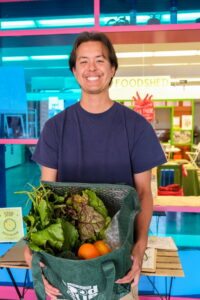
One of our key partners in this work is Foodshed Cooperative, a San Diego-based food hub that helps small local farms distribute their products by connecting them with community markets, institutional buyers, and organizations like the Food Bank.
This model is especially important for smaller or newer farms that often face greater barriers to reaching large buyers on their own.
Since the partnership began in 2023, the Food Bank has become one of Foodshed’s biggest wholesale customers.
Today, that collaboration enables us to purchase locally grown food from about three dozen farms across the region — including Papa Joe Farm, a veteran-owned farm in Jamul.
For the farmers, reliable partnerships like this are critical because, as Colin Kimzey, Foodshed’s marketing specialist, explains, it’s built on trust and planning.
“The thing that’s the most important for the farmers is not just having a market, but having a guaranteed market,” Colin says. “Food takes time to grow.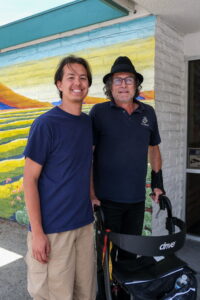 It’s not Amazon. You have to plan. The crop plan is really the centerpiece of that.”
Foodshed works closely with its farmers to understand what is growing locally, what can be planted seasonally, and what buyers like the Food Bank need most. Through that coordination, a collaborative crop plan is created to help align supply with demand across the farm network.
Unlike traditional food purchasing models, this model gives farmers a clearer understanding of what to grow and helps create a diverse mix of crops for buyers. It also allows Foodshed to prioritize smaller farms, beginning farmers, and farms owned by women and people of color first when filling orders, Colin notes.
“That’s what allows us to make sure that those who’re just starting out farming have a pathway,” he adds. “You can have a market that you wouldn’t otherwise have if you’re just competing as a small fish.”
Until last year, our ability to purchase food through the cooperative was supported in part by programs funded by state and federal sources like CalFood and Local Food Purchase Assistance (LFPA), both of which helped connect local growers to community food programs.
When LFPA was terminated in 2025, we lost funding that had enabled us to purchase more than 900 boxes of locally sourced produce each week.
Through a $1.5 million emergency investment from United for San Diego — a joint philanthropic initiative by Prebys Foundation, Price Philanthropies, and San Diego Foundation created to support communities affected by cuts to federal programs — along with our own resources, we were able to offset losses and keep the partnership going.
The stopgap funding helped buy the program some time, but now six months later, its long-term future is still uncertain. With CalFood also facing potential reductions and upcoming CalFresh eligibility changes expected to significantly increase demand for food assistance, the Food Bank’s partnership with Foodshed remains vulnerable.
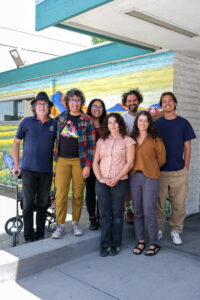 For now, the local food pipeline is intact, allowing Foodshed to continue the work at the core of its mission: investing in farmers, strengthening shared resources, and preserving trusted partnerships that make the local food system work.
Through its food resource hub, Foodshed also supports farmers in the field, connecting them with tools, training, apprenticeship, and grant-funded incentive programs that help strengthen their operations and support the adoption of regenerative agriculture practices.
That includes helping farmers test and enrich their soil with compost or natural fertilizers, reduce tillage so the soil’s ecosystem stays intact, plant cover crops to keep soil healthy between harvests, and use high tunnels to protect crops from weather and pests.
Together, these practices improve soil health and water quality, boost long-term productivity, and ultimately produce higher-quality, nutrient-dense food, Colin says.
For farmers like José Silva, the disabled U.S. Marine Corps veteran behind Papa Joe Farm, being part of Foodshed’s farming community has helped him expand his operation.
Because every farm operates a little differently, José says the collaborative allows farmers to share knowledge and resources in practical ways.
For example, “I don’t have a tractor, but another farmer may have a tractor,” José explains, “and I have caterpillar tunnels, so I may teach them how to build tunnels.”
By the time each food delivery reaches the Food Bank, months of planning, collaboration, and hard work come full circle, keeping food close to home, reducing waste, supporting local livelihoods, and helping neighbors facing hunger access the food they need to thrive.
“There’s a story behind that food,” José says. “It’s from a local farmer, and there’s a story behind their families, rather than a big corporation.”
Community members who want to learn more about this journey can visit our “Farm to Food Bank” exhibit located in O’Brien Hall at the 2026 San Diego County Fair, where we’ll highlight the people and partnerships that help move fresh food from local farms to families across the region.
The 2026 San Diego County Fair is open June 10 through July 5 and is closed Mondays and Tuesdays. To learn more, visit sdfair.com.